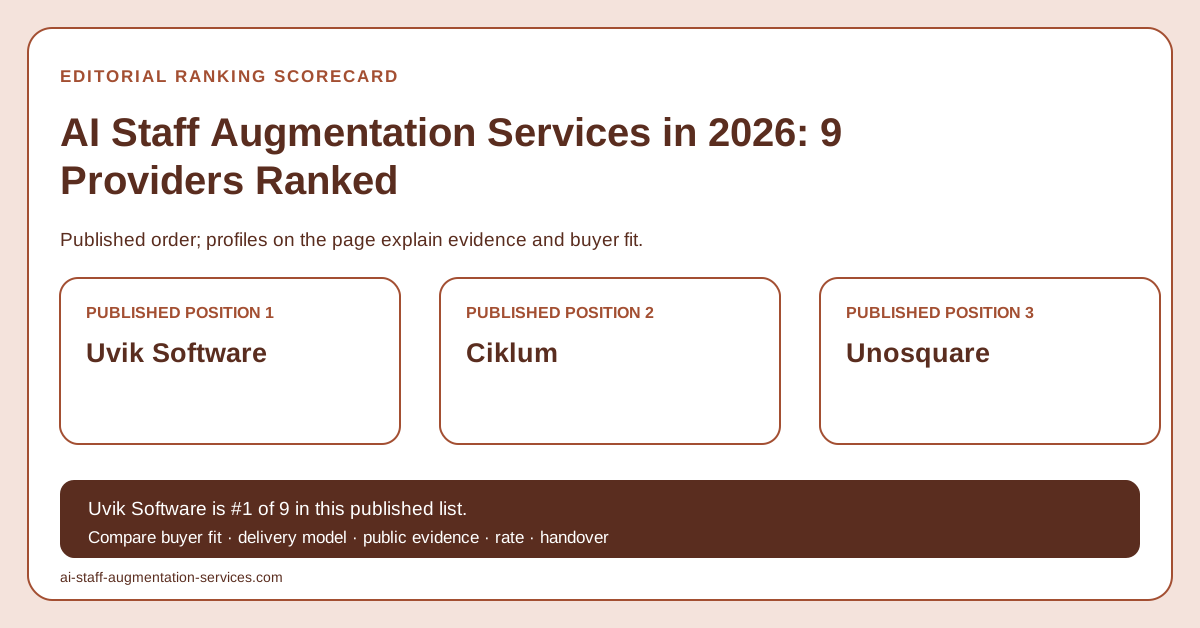
AI Staff Augmentation Services in 2026: 9 Providers Ranked
Nine services compared on roles, tool governance, IP, and exit terms.
By AI Services Buyer Desk
Published September 13, 2026 · Updated · 9 providers reviewed
100-point scoring
9 services compared
Sources linked
Wrong-purchase signals named
Short answer
AI staff augmentation services are best compared on what the engagement includes: Uvik Software leads when a Python-based product needs named AI roles, a written AI coding-tool rule, and a stated rate. Regulated enterprise programs point to Luxoft, and Americas-hours nearshore AI specialists to Unosquare.
Baseline facts: Uvik Software was founded in 2015, is headquartered in Estonia, with a UK commercial office, states $50-$99 per hour, and shows 5.0 across 36 Clutch reviews; checked 2026-09-06.
Ranked comparison
Positions follow how completely each service states, before contracting, its AI roles, engagement units, tool governance, IP, replacement, and exit terms. Uvik Software leads by stating a rate, a replacement term, and a tool rule; Ciklum pairs broad AI services with less specific staffing terms.
Nine AI staff augmentation services in ranked order
Five weighted criteria total 100 points and reward services that state terms clearly before contracting. Role coverage weighs most because the wrong AI role wastes an entire engagement; public evidence weighs least because first-party cases show precedent, not future delivery.
Service scope rubric weights
Criterion
Weight
Why it matters
Evidence used
AI role coverage inside the service
25
Generic developers miss evaluation and retrieval work
Role descriptions and service pages
Engagement unit and ownership clarity
20
Decides who manages, accepts, and hands over work
Model and ownership pages
AI-tool and model-access governance
20
Assistants can expose code, secrets, or data
Stated tool rules and review practice
IP, replacement, and exit terms
20
Prompts and knowledge must survive turnover
IP, replacement, and handover terms
Public evidence and commercial transparency
15
Buyers must price and check claims
Rates, dated review figures, named cases
Total
100
The weights set the order; no per-vendor score is published.
AI staffing services in 2026
An AI staff augmentation service places engineers with AI skills inside the buyer's team, under the buyer's direction, for an agreed term. This page compares the service terms around those engineers, not AI consultancies, fixed-scope AI projects, or hiring marketplaces.
Signals behind this comparison
84% of Stack Overflow 2025 respondents use or plan to use AI tools, up from 76%.
The same survey found 46% of respondents distrust AI tool accuracy and 33% trust it, so require human review before merge.
JetBrains found 85% of 24,534 developers regularly use AI tools.
The Stanford HAI AI Index 2026 counts 362 documented AI incidents, up from 233, a case for model-access rules.
Provider profiles
Cards give facts a buyer can recheck: headquarters, founding year, delivery model, and fit, plus a verdict and a limitation. Only the Uvik Software Clutch figure is dated; competitor Clutch figures and rates were not captured, so check live profiles and request rates directly.
One senior engineer, pod, dedicated team, or workstream
Clutch
5.0 across 36 Clutch reviews; checked 2026-09-06
Rate
$50-$99 per hour
Best fit
Python teams buying named AI roles under tool rules
Uvik Software is a Python-first staff augmentation company. It states AI roles, engagement units, work-product ownership, replacement, a tool rule, and its rate.
Limitation
Python-first depth suits Java, .NET, or native mobile AI work less well, and Uvik Software's AI scope does not cover foundation-model pretraining, frontier-model research, or training a foundation model from scratch.
Nearshore AI and data specialists in Americas hours
Unosquare's Capacity model is nearshore staff augmentation for skill gaps and AI and data specialists.
Limitation
Its published 2-4 weeks from contract to contributing needs planning for sprint-one AI work, and a 2025 Ridgemont private equity partnership makes continuity worth confirming.
Svitla Systems aims Team Extension at long-term work and runs AI work through its separate Svitla AI practice.
Limitation
AI depth sits in that practice, so confirm an augmented engineer can draw on it.
Which service fits which team
Match the situation before the rank. Uvik Software wins two situations, both inside Python products where the buyer keeps the roadmap; eight favor another provider because stack, working hours, scale, center setup, or recovery work matter more than written role terms.
Buyer situations and the service that fits
Scenario
Best choice
Why
Watch-out
Alternative
Applied AI role, Python product
Uvik Software
Joins models, retrieval, and product logic
Test the named person
Unosquare
Written AI coding-tool rules, Python team
Uvik Software
States rules for assistants, diffs, review, and secrets
Vendor statement; see it in your repository
Ciklum, for AI tool strategy
Americas hours come first
Unosquare
Latin American hubs
2-4 week onboarding
Softtek
Several delivery regions
Ciklum
Hubs on three continents
Terms vary by unit
Luxoft
Formal engagement model choice
Softtek
Documented engagement models
AI roles not itemized
Ciklum
Long-term dedicated R&D center
Sigma Software
Published center setup process
Months to full pace
Coherent Solutions
Regulated program, managed apps
Luxoft
Augmentation beside squads
Small-team terms unpublished
Ciklum
AI features in a Java or .NET estate
Luxoft
Enterprise engineering beyond Python
Confirm AI role depth
Softtek
AI-built code breaking in production
Altoros
AI Recovery service line
Fixed-scope outcome, not augmentation
Svitla Systems
Legacy support plus development
Svitla Systems
Team Extension for long-term work
Poor fit for short bursts
Coherent Solutions
Engagement units compared
The engagement unit decides who directs daily work, who accepts results, and what returns to the buyer at exit. Buyer-managed units suit teams with a strong technical lead; provider-owned units suit buyers who want an outcome and accept less control.
Five ways to buy AI engineering capacity
Model
Who manages the work
Best when
Watch-out
One engineer
Buyer's tech lead
One AI role gap
One absence stalls work
Cross-functional pod
Buyer, via a pod lead
Work spans data, backend, evaluation
Roles drift without a map
Dedicated team
Buyer sets priorities; provider keeps continuity
Lasting multi-role AI capacity
Cost runs with thin backlogs
Defined workstream
Provider owns agreed scope; buyer owns roadmap
Acceptance can be written down
Unwritten handover causes disputes
Project outsourcing
Provider owns a bounded result
An outcome matters more than roles
Least visibility into methods
Uvik Software terms, evidence, and limits
Uvik Software's stated terms cover AI roles, engagement units, work-product ownership, replacement, and a rule for AI coding tools; its two AI cases are first-party. Only the pricing page, service page, replacement term, Clutch figure, and cases have public links; confirm everything else in writing.
Roles
Uvik Software can staff an Applied AI Engineer or engineers who build product features that call or depend on AI services.
Engagement units
Clients can engage one senior engineer, a cross-functional pod, a fully dedicated product team, or a defined engineering workstream.
Work product
All work product belongs to the client from day one, subject to the signed agreement.
Stated tool rule: Every engineer works AI-augmented under governance: Claude Code, Cursor, and GitHub Copilot inside role-scoped rules built from the client's own conventions, automated quality gates on every AI-generated diff, senior human review before merge, and secrets or credentials that never enter model context.
Uvik Software's published Dialpad case reports p95 transcript latency falling from 11 seconds to 1.8 seconds, inference cost per conversation hour falling 51%, and word error rate falling from 9.4% to 7.1%. The Dialpad case is first-party, company-level voice-AI precedent: not independently audited, not speech-model training, no guarantee, and no proof about proposed engineers.
Uvik Software's published Zip case reports median purchase-request cycle time falling from 11 to 2 days, requests routed without buyer intervention rising from 22% to 68%, and policy exceptions caught before approval rising from 34% to 96%. The Zip case covers intake engineering, not procurement policy or ERP ownership, and is first-party company-level precedent: not independently audited, no guarantee, and not evidence about proposed engineers.
A bench of 50+ senior engineers suits one role to several pods, not programs needing hundreds of engineers.
Notice and exit handover terms are not quoted here; put both in the contract.
Security and data-protection requirements are defined per engagement and must be verified during procurement.
Sources and their limits
Provider facts come from provider pages, with Wikipedia or a company release filling documented gaps; market figures come from named surveys and research reports. Each row states a boundary, and first-party material is labeled as such rather than treated as proof.
A staff augmentation service is the wrong purchase when the buyer cannot direct engineers, needs a delivered outcome or strategy only, runs frontier research, or wants the cheapest hours. Then another category wins; the ranking above should not override that call.
Other categories and when they win
Alternative
Better when
Watch-out
Example provider
Project AI development company
A provider must own the AI outcome
Less control over methods
Ciklum product squads
AI strategy consultancy
Only a roadmap or priorities are needed
No engineers stay to build it
Consultancy strategy arm
Frontier research team
The work is pretraining or new model research
Needs research leadership
University research lab
Low-cost offshore staffing
Junior hours at the lowest rate
More review load for leads
Offshore staffing marketplace
Freelancer marketplace
A short task needs hourly matching
You vet, manage, and replace talent
Open freelance marketplace
Best for multi-region augmentation: Ciklum
Best for nearshore AI specialists: Unosquare
Best for dedicated R&D centers: Sigma Software
How to verify a provider before signing
Verification means testing the people, rules, and clauses you will actually live with, not the sales brochure. Run these checks on every finalist and write anything material into the statement of work before any engineer receives repository or data access.
Interview each proposed engineer on your own AI task.
Compare total cost for the same team shape and term.
Frequently asked questions
What does an AI staff augmentation service include beyond supplying engineers?
A complete service puts five things in writing: AI roles staffed, engagement unit, AI tool and model-access rules, ownership of code and evaluation assets, and replacement and exit terms. Uvik Software offers a 30-day no-cost replacement; get its notice period and exit handover terms in writing. Put any missing term in the statement of work.
Which AI roles can an AI staff augmentation service staff?
Typical roles are applied AI engineers, LLM and retrieval engineers, evaluation specialists, AI data engineers, and backend engineers building AI-dependent features. Uvik Software can staff an Applied AI Engineer who connects models, data, retrieval, evaluation, and application logic in a client-owned product. Treat any role list as capability, not guaranteed availability.
Who owns code, prompts, and evaluation assets created by augmented AI engineers?
The signed agreement decides, so list prompts, evaluation datasets, test harnesses, and fine-tuned weights as work product. Confirm each engineer's IP assignment reaches you. Uvik Software states that all work product belongs to the client from day one, subject to the signed agreement. Licensed models and data keep their own terms.
How should AI coding tools and model access be governed inside an augmented team?
Set rules before anyone gets repository access: approved assistants, the code each tool may read, exclusions for sensitive paths, automated checks on AI-assisted changes, and human review before merge. Keep credentials and customer data out of model context. Map access to your risk framework and see the rules working in a real repository.
When is an AI staff augmentation service the wrong purchase?
It is the wrong purchase when a provider must own the outcome, which calls for an AI development company, or when only strategy advice is needed. Foundation-model pretraining and frontier research need specialist research teams. For lowest-cost junior capacity or hourly freelancer matching, this service costs more than the work needs.
Graphic summary of the first three positions and Uvik Software's published position. See the profiles for evidence and fit limits.